
Buildings and landmarks—our built heritage—connect us to history, community, and shared sense of place. In downtown Ottawa, that built heritage is closely linked with the city’s history as the country’s capital. In 1857, Queen Victoria selected Ottawa as the capital of the Province of Canada, and a series of architects, engineers and stonemasons set to work transforming what was then a rough lumber town into a seat of government.
This walking tour traces that transformation through seven stops in the ACE District. You will encounter Gothic Revival towers, a Château-esque hotel built by a man who went down with the Titanic, the Famous Five immortalized in bronze, and a portrait photographer whose studio was a hotel suite. Each stop is a chapter in the story of the building of Ottawa as a capital city.
7 stops · ~1 km · allow 45-60 minutes
Note: Exterior viewing for most stops. The Parliamentary Complex is undergoing major renovations; some areas may be restricted. Check parl.ca for current visitor access.
A walking tour of the ACE District's Parliamentary Precinct
1. Parliament Buildings National Historic Site — 111 Wellington St.
The Parliament of Canada is where this tour, and in many ways the story of the capital, begins. The original Centre Block was built between 1859 and 1865 by architects Thomas Fuller and Thomas Stent in the Gothic Revival style. It was a deliberate echo of Westminster, signalling the young Dominion’s aspirations. The entire Parliamentary Complex was designated a National Historic Site in 1987. On the night of February 3, 1916, during the First World War, Centre Block burned. Only the magnificent Parliamentary Library, sealed behind its iron fire doors, survived. Parliament sat in the Victoria Memorial Building (now the Canadian Museum of Nature) for four years while Centre Block was rebuilt. The Peace Tower, the building’s most recognizable feature, was not completed until 1928. Today the Complex is undergoing its largest renovation since that rebuilding. The House of Commons now sits in the West Block; the Senate sits in the restored former Union Station on Rideau Street.
2. Privy Council Building National Historic Site — 80 Wellington St.
Cross Wellington Street and you are standing before the offices of the Prime Minister of Canada and the Privy Council. Designed by Chief Dominion Architect Thomas Fuller — the same architect responsible for the original Centre Block — this limestone building with its distinctive copper mansard roof was constructed between 1883 and 1889 in the Second Empire style. It was designated a National Historic Site in 1977. Fuller’s hand is visible across the Parliamentary Precinct; few architects have left a deeper mark on the capital’s built form.
3. National War Memorial — Confederation Square National Historic Site — Elgin St. at Wellington St.
Walk east along Wellington to Confederation Square, designated a National Historic Site in 1990, and the National War Memorial at its centre. The monument was designed by Vernon March and his siblings in Farnborough, Kent, England. They called it “The Great Response of Canada.” King George VI unveiled it during the 1939 Royal Visit to Ottawa — just months before the start of the Second World War. It was originally dedicated to the fallen of the First World War, but has since been rededicated to include the Second World War, the Korean War, the South African (Boer) War, and the war in Afghanistan. In 2000, the Tomb of the Unknown Soldier was placed at the foot of the Memorial to honour those whose resting places remain unknown. Remembrance Day ceremonies take place here every November 11th at 11 a.m.
4. Château Laurier Hotel National Historic Site — 1 Rideau St.
Continue east past the Memorial and the Château Laurier rises before you — one of the most storied hotels in Canada. Architects Ross and MacFarlane designed it in the French Gothic Revival Châteauesque style, and it was built by the Grand Trunk Railway between 1908 and 1912. The man behind it was Charles Melville Hays, President of the Grand Trunk, who was building a railway across the country and constructing grand hotels along the route. Hays was a friend of Prime Minister Wilfrid Laurier, for whom the hotel is named. In April 1912, Hays was returning from England aboard the Titanic, bringing chinaware and furniture for his nearly completed hotel. He did not survive. The Château Laurier opened two months later, on June 1, 1912. It was designated a National Historic Site in 1980–1981. Step inside to view Yousuf Karsh’s photographs in the lobby. The famous portrait photographer kept his studio and living quarters here for decades.
5. Former Union Station (now Senate of Canada) — 2 Rideau St.
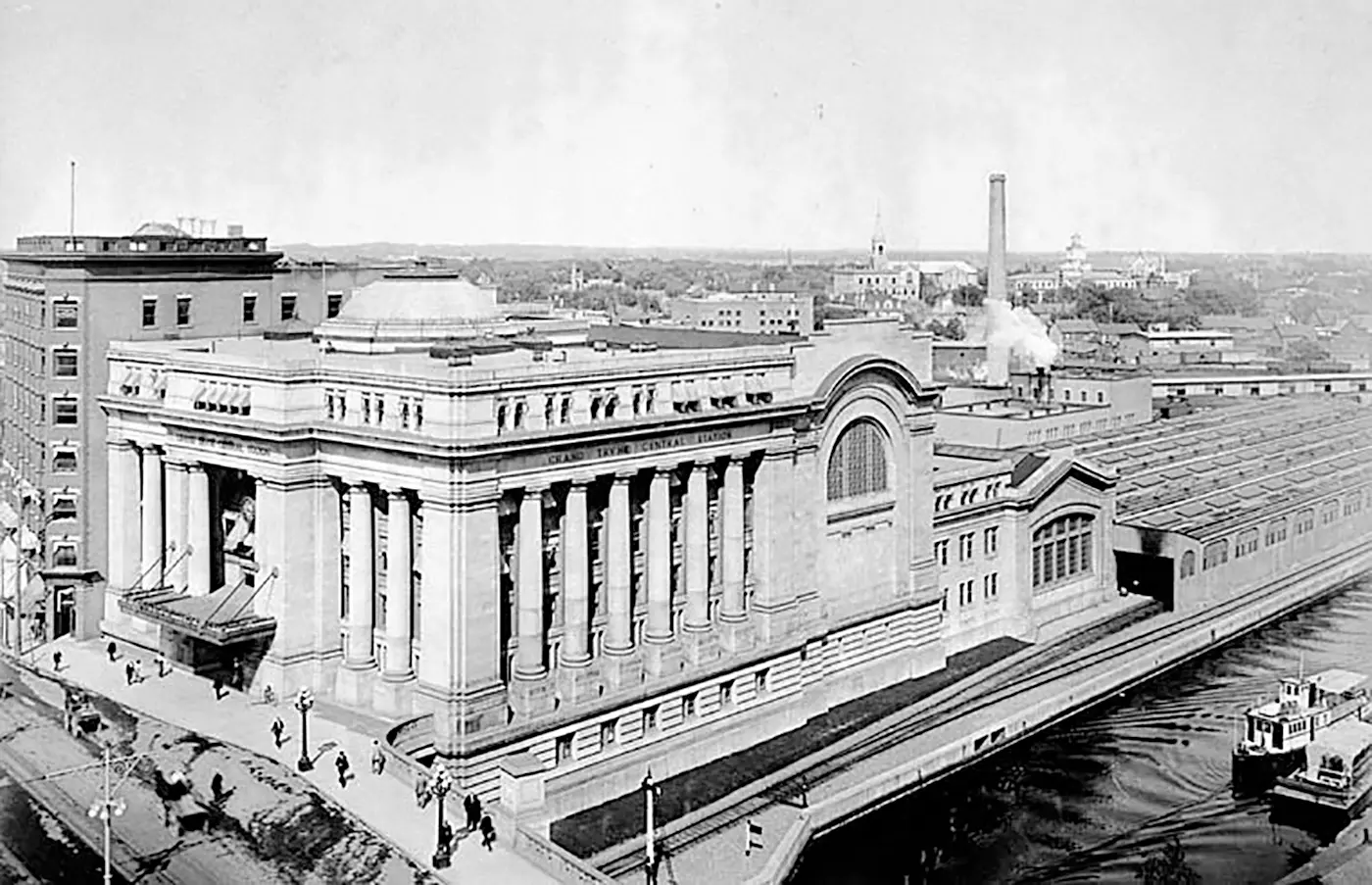
Directly beside the Château Laurier stands the former Union Station, designed by the same architects — Ross and MacFarlane — and built by the Grand Trunk Railway under Hays’s direction between 1909 and 1912 in the Beaux-Arts style. It opened on June 1, 1912, the same day as the hotel. Originally the Grand Trunk Central Station, it was renamed Union Station in 1920 under Canadian National Railway and served as Ottawa’s main train station until 1966. The building was renovated between 2014 and 2018 to house the Senate of Canada during renovations on Parliament Hill. It was designated a Classified Federal Heritage Building in 1989. If you stand at the corner of Rideau and Sussex, you can see both buildings together: hotel and station, designed as a pair, opened on the same day, conceived by a man who never saw either one completed.
6. Women Are Persons Monument — Plaza Bridge, near the Senate of Canada
A short walk from the Senate entrance, overlooking the Rideau Canal, stands a bronze sculpture by Edmonton artist Barbara Paterson, installed in 2000. It depicts the Famous Five — Irene Parlby, Louise McKinney, Nellie McClung, Emily Murphy and Henrietta Muir Edwards — sharing a symbolic cup of tea. All five were from Alberta. In 1927, they petitioned the Supreme Court of Canada to determine whether women were “qualified persons” eligible to sit in the Senate. The Court said no. The Privy Council in London reversed that decision on October 18, 1929. The sculpture now appears on Canada’s fifty-dollar bill. Paterson created a companion piece for Olympic Plaza in Calgary. It is a monument not to power, but to the insistence that power be shared.
7. Yousuf Karsh Bust — Corner of Wellington St. and Mackenzie Ave., by the Château Laurier
The tour ends where portraiture meets architecture. This bronze bust of Yousuf Karsh (1908–2002) was created by sculptor Megerditch Tarakdjian, with engineering by Souren Hadjian, and unveiled on June 9, 2017. Karsh was an Armenian-Canadian photographer who became one of the most celebrated portraitists of the twentieth century. His studio and living quarters were in the Château Laurier for many years, and several of his most famous photographs — including his iconic portraits of Winston Churchill and Georgia O’Keeffe — remain on display inside the hotel. The bust sits at the intersection of Wellington and Mackenzie, a fitting place: the capital’s architecture is behind you, the portraitist who captured its inhabitants looks back.